
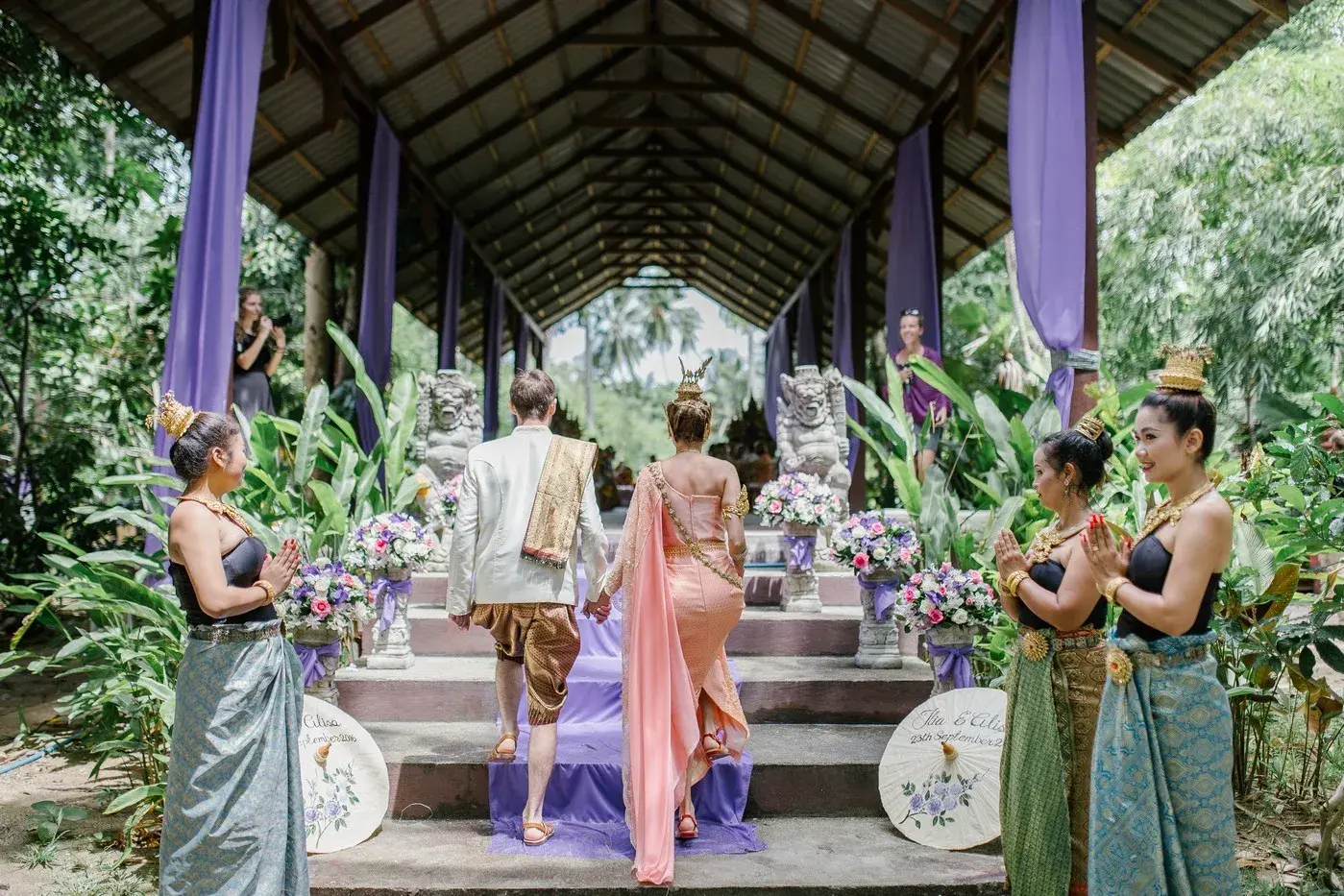
A beautiful Thai wedding can feel both deeply symbolic and surprisingly intimate - even when you are planning it from another country. If you are looking for a thai wedding ceremony guide, the first thing to know is this: there is no single script. Thai weddings are wonderfully adaptable, and the right ceremony depends on how traditional you want to be, how many guests you are hosting, and how you want the day to feel.
For some couples, the appeal is cultural meaning. For others, it is the grace of the rituals, the blessing of family, and the softness of a ceremony that feels warm rather than formal. And for many destination couples, a Thai wedding is not about reproducing every custom exactly as a local family would. It is about creating a respectful, beautiful experience that honors Thai tradition while still feeling personal.
What a Thai wedding ceremony usually includes
A traditional Thai ceremony is often made up of several parts rather than one continuous exchange of vows. The sequence can vary by region, family background, and whether the wedding is fully traditional or adapted for an international couple. That flexibility is part of what makes it so appealing.
One of the most recognized moments is the water blessing ceremony, often called Rod Nam Sang. Guests gently pour blessed water over the couple's hands while offering good wishes for marriage. It is elegant, photogenic, and emotionally rich without feeling theatrical. For many international couples, this is the part they connect with most immediately because it is easy for guests to understand and meaningful to participate in.
Another familiar element is the Sai Monkhon ritual, in which a ceremonial headpiece or linked floral garland connects the couple as a symbol of unity. Monks or an officiant may also offer blessings, depending on the format you choose. In more traditional family weddings, there may be a Khan Maak procession, where the groom arrives with gifts and symbolic offerings, often with music, laughter, and a sense of celebration before the formal ceremony even begins.
Not every wedding includes every ritual. A private villa celebration with 20 guests may feature a simplified blessing ceremony and water pouring ritual, while a larger wedding with strong family involvement may include a fuller sequence with processions, engagement customs, and monk blessings earlier in the day.
A thai wedding ceremony guide to choosing the right format
The most important planning question is not whether you want a Thai wedding in the abstract. It is which version fits your relationship, your guests, and your comfort level.
If you want something serene and symbolic, a Thai blessing ceremony can be woven into a modern destination wedding without asking guests to follow a long schedule or unfamiliar customs. This works especially well for couples who want to honor Thailand as their wedding setting while keeping the tone relaxed and refined.
If cultural authenticity is your priority, you may want a more traditional structure with a morning ceremony, family participation, and multiple ritual stages. That choice often feels more layered and meaningful, but it also requires stronger coordination and clearer guest guidance. Some couples love that depth. Others prefer a shorter ceremony that preserves the spirit without the full timeline.
It also depends on who the wedding is for. If you are celebrating with Thai family members, tradition may carry a different emotional weight than it would for a couple hosting only international guests. In that case, the ceremony may be less about aesthetics and more about respect, family presence, and shared meaning.
How destination couples usually blend Thai tradition with a modern wedding
This is where thoughtful planning matters most. The most memorable celebrations tend to blend, not copy. A couple might begin with a Thai water blessing in the afternoon, followed by personal vows at sunset and a dinner reception under the palms. Another might host a monk blessing in the morning for close family, then move into a Western-style ceremony for all guests later in the day.
There is no rule that says you must choose one tradition and exclude the other. In fact, many of the most visually elegant weddings in Thailand are built around a balanced mix of ceremony styles. A Thai ritual adds depth and place. A custom vow exchange adds personal voice. Together, they create something that feels rooted and original.
The trade-off is timing. Hybrid weddings need careful pacing so the day feels intentional rather than crowded. If you try to fit every meaningful ritual, a full photo session, cocktails, dinner, speeches, and dancing into one afternoon, the celebration can start to feel rushed. The better approach is usually to choose the moments that matter most and give them room.
Ceremony timing, dress, and etiquette
Traditional Thai ceremonies often take place in the morning, especially when monks are involved. That timing reflects custom, but it also creates a softer, more contemplative mood. If your dream is a beachfront sunset wedding, you may want to reserve Thai rituals for an earlier private ceremony and save the evening for a separate celebration.
Dress also deserves a little thought. Thai wedding attire can be stunning, from classic silk ensembles to more contemporary interpretations. Some international couples wear traditional Thai outfits for the ceremonial portion and change into Western wedding attire later. That can be a lovely way to honor the experience without feeling locked into one look for the full day.
Etiquette matters, especially if monks are present. Modest clothing, respectful behavior, and proper ceremony setup are all essential. Women generally should not touch monks, and the ceremony area should be arranged according to local expectations. These details are easy to manage with the right guidance, but they should never be treated as decorative extras. Respect is what makes the ceremony feel graceful rather than staged.
Planning a Thai wedding ceremony from overseas
A strong thai wedding ceremony guide should be honest about this part: the beauty is easy to imagine, but overseas coordination is where couples feel the most pressure. The challenge is not just booking a venue. It is understanding what is culturally appropriate, what is logistically realistic, and what will actually feel smooth on the day.
This is why local expertise matters so much. The right planner can explain which rituals suit your priorities, source the correct ceremonial elements, coordinate attire, brief your guests, and make sure the ceremony is presented with care rather than approximation. That support becomes even more valuable if you are combining traditions, planning a villa wedding, or organizing events across multiple days.
Venue type also shapes the ceremony more than many couples expect. A garden setting may feel ideal for a water blessing with floral styling and low seating, while a beachfront venue may need a more adapted format due to wind, light, and layout. In places like Koh Samui or Phuket, the scenery is extraordinary, but practical details still matter - access, privacy, weather backup, and where guests will gather during each stage of the celebration.
Budget plays a role too. A Thai ceremony can be remarkably elegant without becoming excessive, but costs vary depending on guest count, floral design, ceremonial setup, live musicians, wardrobe, and whether the event includes multiple rituals. It helps to decide early whether your priority is cultural detail, visual styling, or a full wedding weekend experience. Most couples want all three. Usually, one has to lead.
How to make the ceremony feel meaningful, not performative
This is the question thoughtful couples ask, and rightly so. If you are not Thai, it is reasonable to wonder how to approach these traditions with sincerity.
The answer is intention. Learn what each ritual means. Choose elements because they resonate with you, not because they look good in photos alone. Ask for proper guidance on language, order, and etiquette. If a ritual feels too symbolic to include without a deeper family or cultural connection, you can keep the inspiration while choosing a simpler format.
Guests respond to authenticity. When the ceremony is introduced clearly and held with warmth, people understand its significance even if they have never seen it before. A short explanation from the officiant or planner can transform the experience from unfamiliar to deeply moving.
For couples who want a celebration that feels elevated, personal, and easy to trust, a carefully planned Thai ceremony offers something rare. It is visually exquisite, yes, but more than that, it creates a sense of presence. The rituals slow the day down. They invite blessing, family, and reflection into a moment that could otherwise pass too quickly.
At ThaiWith.Love, we have seen how powerfully this style of ceremony speaks to couples who want more than a pretty setting. They want a wedding that feels anchored in place and memory. If that is what you are dreaming of, the most beautiful choice is usually the one that feels both respectful and unmistakably your own.
Start there, and the rest of the celebration tends to fall into place with surprising ease.
For some couples, the appeal is cultural meaning. For others, it is the grace of the rituals, the blessing of family, and the softness of a ceremony that feels warm rather than formal. And for many destination couples, a Thai wedding is not about reproducing every custom exactly as a local family would. It is about creating a respectful, beautiful experience that honors Thai tradition while still feeling personal.
What a Thai wedding ceremony usually includes
A traditional Thai ceremony is often made up of several parts rather than one continuous exchange of vows. The sequence can vary by region, family background, and whether the wedding is fully traditional or adapted for an international couple. That flexibility is part of what makes it so appealing.
One of the most recognized moments is the water blessing ceremony, often called Rod Nam Sang. Guests gently pour blessed water over the couple's hands while offering good wishes for marriage. It is elegant, photogenic, and emotionally rich without feeling theatrical. For many international couples, this is the part they connect with most immediately because it is easy for guests to understand and meaningful to participate in.
Another familiar element is the Sai Monkhon ritual, in which a ceremonial headpiece or linked floral garland connects the couple as a symbol of unity. Monks or an officiant may also offer blessings, depending on the format you choose. In more traditional family weddings, there may be a Khan Maak procession, where the groom arrives with gifts and symbolic offerings, often with music, laughter, and a sense of celebration before the formal ceremony even begins.
Not every wedding includes every ritual. A private villa celebration with 20 guests may feature a simplified blessing ceremony and water pouring ritual, while a larger wedding with strong family involvement may include a fuller sequence with processions, engagement customs, and monk blessings earlier in the day.
A thai wedding ceremony guide to choosing the right format
The most important planning question is not whether you want a Thai wedding in the abstract. It is which version fits your relationship, your guests, and your comfort level.
If you want something serene and symbolic, a Thai blessing ceremony can be woven into a modern destination wedding without asking guests to follow a long schedule or unfamiliar customs. This works especially well for couples who want to honor Thailand as their wedding setting while keeping the tone relaxed and refined.
If cultural authenticity is your priority, you may want a more traditional structure with a morning ceremony, family participation, and multiple ritual stages. That choice often feels more layered and meaningful, but it also requires stronger coordination and clearer guest guidance. Some couples love that depth. Others prefer a shorter ceremony that preserves the spirit without the full timeline.
It also depends on who the wedding is for. If you are celebrating with Thai family members, tradition may carry a different emotional weight than it would for a couple hosting only international guests. In that case, the ceremony may be less about aesthetics and more about respect, family presence, and shared meaning.
How destination couples usually blend Thai tradition with a modern wedding
This is where thoughtful planning matters most. The most memorable celebrations tend to blend, not copy. A couple might begin with a Thai water blessing in the afternoon, followed by personal vows at sunset and a dinner reception under the palms. Another might host a monk blessing in the morning for close family, then move into a Western-style ceremony for all guests later in the day.
There is no rule that says you must choose one tradition and exclude the other. In fact, many of the most visually elegant weddings in Thailand are built around a balanced mix of ceremony styles. A Thai ritual adds depth and place. A custom vow exchange adds personal voice. Together, they create something that feels rooted and original.
The trade-off is timing. Hybrid weddings need careful pacing so the day feels intentional rather than crowded. If you try to fit every meaningful ritual, a full photo session, cocktails, dinner, speeches, and dancing into one afternoon, the celebration can start to feel rushed. The better approach is usually to choose the moments that matter most and give them room.
Ceremony timing, dress, and etiquette
Traditional Thai ceremonies often take place in the morning, especially when monks are involved. That timing reflects custom, but it also creates a softer, more contemplative mood. If your dream is a beachfront sunset wedding, you may want to reserve Thai rituals for an earlier private ceremony and save the evening for a separate celebration.
Dress also deserves a little thought. Thai wedding attire can be stunning, from classic silk ensembles to more contemporary interpretations. Some international couples wear traditional Thai outfits for the ceremonial portion and change into Western wedding attire later. That can be a lovely way to honor the experience without feeling locked into one look for the full day.
Etiquette matters, especially if monks are present. Modest clothing, respectful behavior, and proper ceremony setup are all essential. Women generally should not touch monks, and the ceremony area should be arranged according to local expectations. These details are easy to manage with the right guidance, but they should never be treated as decorative extras. Respect is what makes the ceremony feel graceful rather than staged.
Planning a Thai wedding ceremony from overseas
A strong thai wedding ceremony guide should be honest about this part: the beauty is easy to imagine, but overseas coordination is where couples feel the most pressure. The challenge is not just booking a venue. It is understanding what is culturally appropriate, what is logistically realistic, and what will actually feel smooth on the day.
This is why local expertise matters so much. The right planner can explain which rituals suit your priorities, source the correct ceremonial elements, coordinate attire, brief your guests, and make sure the ceremony is presented with care rather than approximation. That support becomes even more valuable if you are combining traditions, planning a villa wedding, or organizing events across multiple days.
Venue type also shapes the ceremony more than many couples expect. A garden setting may feel ideal for a water blessing with floral styling and low seating, while a beachfront venue may need a more adapted format due to wind, light, and layout. In places like Koh Samui or Phuket, the scenery is extraordinary, but practical details still matter - access, privacy, weather backup, and where guests will gather during each stage of the celebration.
Budget plays a role too. A Thai ceremony can be remarkably elegant without becoming excessive, but costs vary depending on guest count, floral design, ceremonial setup, live musicians, wardrobe, and whether the event includes multiple rituals. It helps to decide early whether your priority is cultural detail, visual styling, or a full wedding weekend experience. Most couples want all three. Usually, one has to lead.
How to make the ceremony feel meaningful, not performative
This is the question thoughtful couples ask, and rightly so. If you are not Thai, it is reasonable to wonder how to approach these traditions with sincerity.
The answer is intention. Learn what each ritual means. Choose elements because they resonate with you, not because they look good in photos alone. Ask for proper guidance on language, order, and etiquette. If a ritual feels too symbolic to include without a deeper family or cultural connection, you can keep the inspiration while choosing a simpler format.
Guests respond to authenticity. When the ceremony is introduced clearly and held with warmth, people understand its significance even if they have never seen it before. A short explanation from the officiant or planner can transform the experience from unfamiliar to deeply moving.
For couples who want a celebration that feels elevated, personal, and easy to trust, a carefully planned Thai ceremony offers something rare. It is visually exquisite, yes, but more than that, it creates a sense of presence. The rituals slow the day down. They invite blessing, family, and reflection into a moment that could otherwise pass too quickly.
At ThaiWith.Love, we have seen how powerfully this style of ceremony speaks to couples who want more than a pretty setting. They want a wedding that feels anchored in place and memory. If that is what you are dreaming of, the most beautiful choice is usually the one that feels both respectful and unmistakably your own.
Start there, and the rest of the celebration tends to fall into place with surprising ease.