
A Thai wedding can feel breathtakingly graceful from the outside - flower garlands, soft blessings, golden trays, water poured over joined hands - but what makes it truly memorable is the meaning behind each moment. For couples searching for the best Thai wedding rituals explained in a way that feels clear, respectful, and useful, the real question is not which traditions are most famous. It is which ones feel right for your story, your guests, and the kind of wedding experience you want to create in Thailand.
Traditional Thai wedding rituals are not a single fixed script. They are a collection of meaningful customs, and couples often include some elements rather than every ceremonial step. That flexibility is part of their beauty. You can honor Thai culture in a way that feels elegant and sincere, whether you are planning an intimate villa celebration, a beachfront ceremony, or a larger destination wedding with family traveling in from several countries.
Best Thai wedding rituals explained for destination couples
If you are planning from abroad, it helps to think of Thai rituals in two layers. The first is symbolism - blessing, unity, respect, prosperity, and family connection. The second is practical flow - what photographs beautifully, what guests can easily follow, and what fits your timeline. The most successful celebrations balance both.
One of the most recognized rituals is the khan maak procession. Traditionally, the groom arrives with a joyful parade carrying gifts and symbolic offerings to the bride's family. Music, dancing, and playful energy are often part of the entrance. In a destination setting, this ritual brings instant personality to the day because it creates movement and emotion from the very beginning.
What makes the khan maak especially appealing for international couples is that it is festive without being confusing. Guests immediately understand that something meaningful is happening, even if they do not know every symbol. It also works beautifully at private villas and garden venues where there is space for a proper arrival. If your celebration is very intimate or held in a compact venue, the procession may need a simplified version.
Then there is the symbolic door ceremony, often folded into the procession. As the groom approaches the bride, he encounters a series of "gates" held by friends or family. To pass, he offers small envelopes or completes lighthearted challenges. This part is playful, but it carries a deeper message too. Marriage is not entered casually. It is approached with effort, respect, and a sense of joy.
For many couples, this is one of the easiest Thai traditions to love because it invites laughter and family participation. It can also be adapted carefully for mixed-nationality groups. The key is tone. If you want a refined, romantic morning, the games should stay charming rather than chaotic.
The rituals that feel most intimate
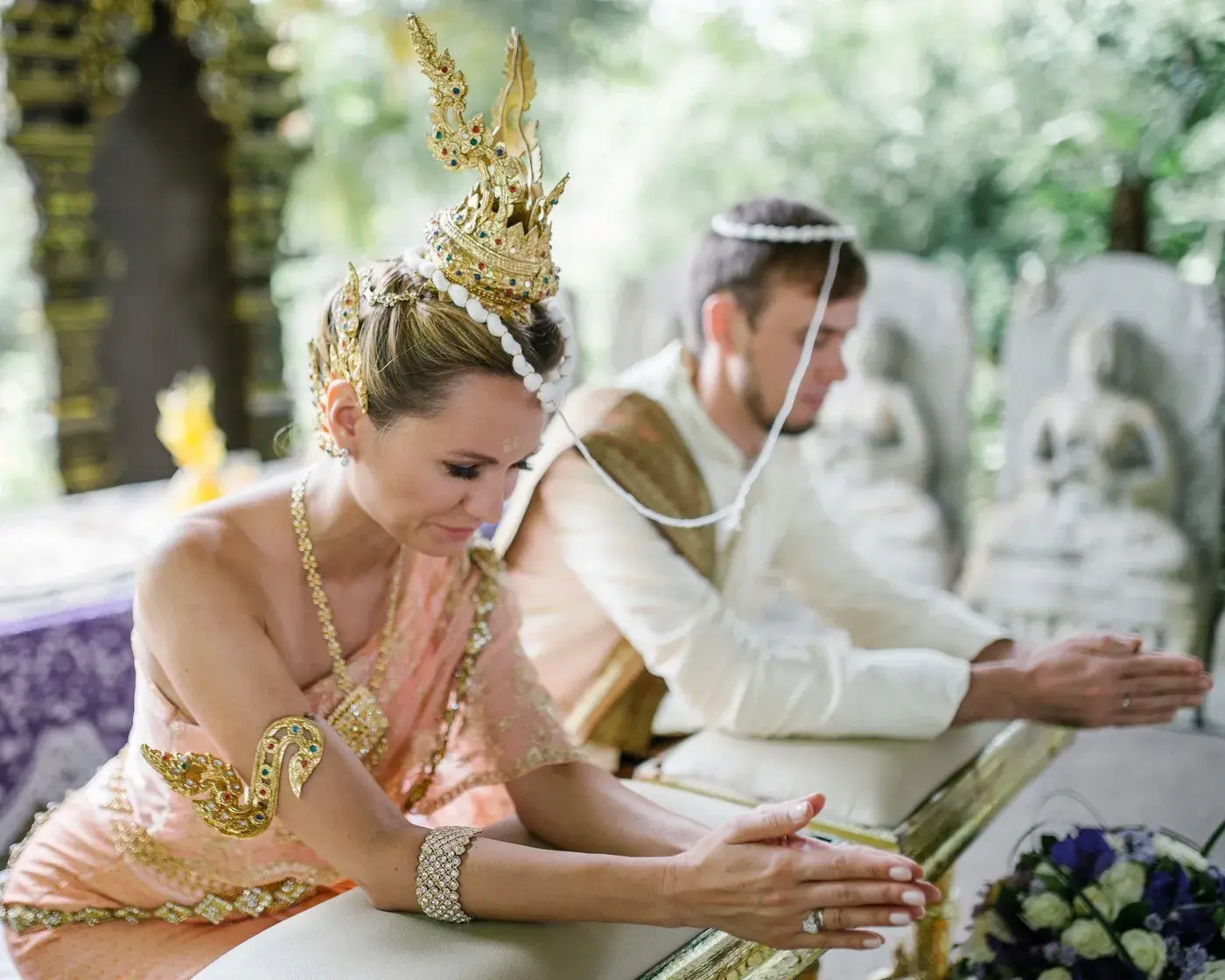
If there is one ceremony that many couples remember most vividly, it is the sai monkhon and rod nam sang sequence. During the sai monkhon, a sacred head cord connects the couple, symbolizing unity. After that, guests or honored elders pour blessed water over the couple's hands while offering wishes for marriage.
This is often the emotional center of a Thai wedding. It is quiet, visual, and deeply moving. Even guests who are unfamiliar with Thai customs tend to feel the tenderness of the moment immediately. The photographs are also timeless - hands gently joined, floral details, soft expressions, and blessings shared one by one.
The appeal here is not only aesthetic. It creates a rare pause in the day. Destination weddings can be full of activity, travel schedules, and social energy. The water blessing slows everything down. It allows family members to express love in a direct, graceful way.
That said, the pace matters. If you have a large guest count, inviting every single guest to pour water may stretch the ceremony too long. In those cases, it often works better to invite parents, siblings, grandparents, and a select group of meaningful guests. The experience remains intimate rather than becoming repetitive.
Another ritual with strong emotional weight is the garland exchange. Floral garlands are offered between the couple as a sign of respect and affection. In some weddings, this is a smaller ceremonial detail. In others, it becomes a lovely visual transition within the broader Thai ceremony.
The reason this ritual works so well for destination weddings is its simplicity. It is easy for guests to understand, easy to style beautifully, and easy to blend with Western elements if you are creating a hybrid celebration. It does not require lengthy explanation, yet it still feels rooted in tradition.
Choosing the best Thai wedding rituals explained by meaning
The best way to choose Thai rituals is not to ask which are most traditional in the abstract. It is to ask what you want your ceremony to feel like.
If you want a wedding morning filled with energy, family interaction, and a sense of occasion, the khan maak procession and door ceremony are strong choices. They create anticipation and invite guests into the story.
If you want a gentle, heartfelt ceremony with a spiritual atmosphere, the sai monkhon and water blessing are often the most powerful. They are also the rituals that many couples find easiest to connect with emotionally, even if they are not Thai.
If you want a subtle cultural layer rather than a full traditional ceremony, garland exchange and selected blessing rituals may be enough. This can be the right decision for couples who love Thai culture but prefer a shorter ceremony, especially if they are also planning Western vows later in the day.
There is no single correct combination. Some couples want a richly traditional morning followed by a sunset reception. Others prefer a Western ceremony with one or two Thai elements woven in. Both approaches can be thoughtful and beautiful if they are planned with care.
What international couples should know before including Thai rituals
Respectful presentation matters as much as the ritual itself. Thai ceremonies are elegant by nature, and they should never feel like a themed performance. This is where good planning makes an enormous difference. A well-guided ceremony helps guests understand what is happening, when to participate, and why each moment matters.
It is also worth thinking about attire, heat, and timing. Some rituals work best in the cooler part of the morning, especially if you are outdoors in places like Phuket or Koh Samui. Formal Thai-inspired styling can look extraordinary, but comfort should still be considered, particularly for multi-part celebrations.
Family expectations may shape your choices too. If one partner is Thai or has Thai family connections, certain rituals may carry personal significance beyond their visual beauty. If neither partner is Thai, intention becomes even more important. Couples who approach the ceremony with genuine appreciation usually find that guests respond warmly.
Language is another practical detail. A bilingual emcee or planner can transform the experience. Brief explanations given at the right moments help international guests feel included without turning the ceremony into a lecture. The goal is always the same - preserve the grace of the ritual while making it accessible.
For this reason, many destination couples work with a local specialist such as ThaiWith.Love to shape a ceremony that feels authentic rather than overwhelming. The difference is often in the curation: knowing which rituals fit the venue, the guest mix, and the emotional pace of the day.
When a full traditional Thai wedding may not be the best fit
Not every couple needs a complete traditional format. That is not a compromise. It is often a sign of thoughtful planning.
If your guest list is mostly international and your priority is a short ceremony before cocktails and dinner, a condensed Thai blessing may feel more natural. If you are eloping, the quieter rituals often make more sense than the processional ones. If you are hosting a large celebration with several cultural backgrounds represented, a blended ceremony may feel most personal.
The trade-off is simple. The more rituals you include, the richer the cultural immersion can be, but the more coordination, explanation, and time you will need. A shorter format may be easier logistically, though it will not create the same ceremonial depth. Neither choice is better on its own.
What matters most is cohesion. A beautiful destination wedding does not feel crowded with traditions for the sake of variety. It feels intentional from beginning to end.
The most memorable Thai wedding rituals are the ones that create a feeling your guests carry home with them - the joy of the groom's arrival, the laughter at the gates, the stillness of hands joined in blessing, the sense that this was not only beautiful to watch but meaningful to witness. If you choose from that place, your ceremony will feel less like a checklist and more like a beginning worth honoring.
Traditional Thai wedding rituals are not a single fixed script. They are a collection of meaningful customs, and couples often include some elements rather than every ceremonial step. That flexibility is part of their beauty. You can honor Thai culture in a way that feels elegant and sincere, whether you are planning an intimate villa celebration, a beachfront ceremony, or a larger destination wedding with family traveling in from several countries.
Best Thai wedding rituals explained for destination couples
If you are planning from abroad, it helps to think of Thai rituals in two layers. The first is symbolism - blessing, unity, respect, prosperity, and family connection. The second is practical flow - what photographs beautifully, what guests can easily follow, and what fits your timeline. The most successful celebrations balance both.
One of the most recognized rituals is the khan maak procession. Traditionally, the groom arrives with a joyful parade carrying gifts and symbolic offerings to the bride's family. Music, dancing, and playful energy are often part of the entrance. In a destination setting, this ritual brings instant personality to the day because it creates movement and emotion from the very beginning.
What makes the khan maak especially appealing for international couples is that it is festive without being confusing. Guests immediately understand that something meaningful is happening, even if they do not know every symbol. It also works beautifully at private villas and garden venues where there is space for a proper arrival. If your celebration is very intimate or held in a compact venue, the procession may need a simplified version.
Then there is the symbolic door ceremony, often folded into the procession. As the groom approaches the bride, he encounters a series of "gates" held by friends or family. To pass, he offers small envelopes or completes lighthearted challenges. This part is playful, but it carries a deeper message too. Marriage is not entered casually. It is approached with effort, respect, and a sense of joy.
For many couples, this is one of the easiest Thai traditions to love because it invites laughter and family participation. It can also be adapted carefully for mixed-nationality groups. The key is tone. If you want a refined, romantic morning, the games should stay charming rather than chaotic.
The rituals that feel most intimate
If there is one ceremony that many couples remember most vividly, it is the sai monkhon and rod nam sang sequence. During the sai monkhon, a sacred head cord connects the couple, symbolizing unity. After that, guests or honored elders pour blessed water over the couple's hands while offering wishes for marriage.
This is often the emotional center of a Thai wedding. It is quiet, visual, and deeply moving. Even guests who are unfamiliar with Thai customs tend to feel the tenderness of the moment immediately. The photographs are also timeless - hands gently joined, floral details, soft expressions, and blessings shared one by one.
The appeal here is not only aesthetic. It creates a rare pause in the day. Destination weddings can be full of activity, travel schedules, and social energy. The water blessing slows everything down. It allows family members to express love in a direct, graceful way.
That said, the pace matters. If you have a large guest count, inviting every single guest to pour water may stretch the ceremony too long. In those cases, it often works better to invite parents, siblings, grandparents, and a select group of meaningful guests. The experience remains intimate rather than becoming repetitive.
Another ritual with strong emotional weight is the garland exchange. Floral garlands are offered between the couple as a sign of respect and affection. In some weddings, this is a smaller ceremonial detail. In others, it becomes a lovely visual transition within the broader Thai ceremony.
The reason this ritual works so well for destination weddings is its simplicity. It is easy for guests to understand, easy to style beautifully, and easy to blend with Western elements if you are creating a hybrid celebration. It does not require lengthy explanation, yet it still feels rooted in tradition.
Choosing the best Thai wedding rituals explained by meaning
The best way to choose Thai rituals is not to ask which are most traditional in the abstract. It is to ask what you want your ceremony to feel like.
If you want a wedding morning filled with energy, family interaction, and a sense of occasion, the khan maak procession and door ceremony are strong choices. They create anticipation and invite guests into the story.
If you want a gentle, heartfelt ceremony with a spiritual atmosphere, the sai monkhon and water blessing are often the most powerful. They are also the rituals that many couples find easiest to connect with emotionally, even if they are not Thai.
If you want a subtle cultural layer rather than a full traditional ceremony, garland exchange and selected blessing rituals may be enough. This can be the right decision for couples who love Thai culture but prefer a shorter ceremony, especially if they are also planning Western vows later in the day.
There is no single correct combination. Some couples want a richly traditional morning followed by a sunset reception. Others prefer a Western ceremony with one or two Thai elements woven in. Both approaches can be thoughtful and beautiful if they are planned with care.
What international couples should know before including Thai rituals
Respectful presentation matters as much as the ritual itself. Thai ceremonies are elegant by nature, and they should never feel like a themed performance. This is where good planning makes an enormous difference. A well-guided ceremony helps guests understand what is happening, when to participate, and why each moment matters.
It is also worth thinking about attire, heat, and timing. Some rituals work best in the cooler part of the morning, especially if you are outdoors in places like Phuket or Koh Samui. Formal Thai-inspired styling can look extraordinary, but comfort should still be considered, particularly for multi-part celebrations.
Family expectations may shape your choices too. If one partner is Thai or has Thai family connections, certain rituals may carry personal significance beyond their visual beauty. If neither partner is Thai, intention becomes even more important. Couples who approach the ceremony with genuine appreciation usually find that guests respond warmly.
Language is another practical detail. A bilingual emcee or planner can transform the experience. Brief explanations given at the right moments help international guests feel included without turning the ceremony into a lecture. The goal is always the same - preserve the grace of the ritual while making it accessible.
For this reason, many destination couples work with a local specialist such as ThaiWith.Love to shape a ceremony that feels authentic rather than overwhelming. The difference is often in the curation: knowing which rituals fit the venue, the guest mix, and the emotional pace of the day.
When a full traditional Thai wedding may not be the best fit
Not every couple needs a complete traditional format. That is not a compromise. It is often a sign of thoughtful planning.
If your guest list is mostly international and your priority is a short ceremony before cocktails and dinner, a condensed Thai blessing may feel more natural. If you are eloping, the quieter rituals often make more sense than the processional ones. If you are hosting a large celebration with several cultural backgrounds represented, a blended ceremony may feel most personal.
The trade-off is simple. The more rituals you include, the richer the cultural immersion can be, but the more coordination, explanation, and time you will need. A shorter format may be easier logistically, though it will not create the same ceremonial depth. Neither choice is better on its own.
What matters most is cohesion. A beautiful destination wedding does not feel crowded with traditions for the sake of variety. It feels intentional from beginning to end.
The most memorable Thai wedding rituals are the ones that create a feeling your guests carry home with them - the joy of the groom's arrival, the laughter at the gates, the stillness of hands joined in blessing, the sense that this was not only beautiful to watch but meaningful to witness. If you choose from that place, your ceremony will feel less like a checklist and more like a beginning worth honoring.