
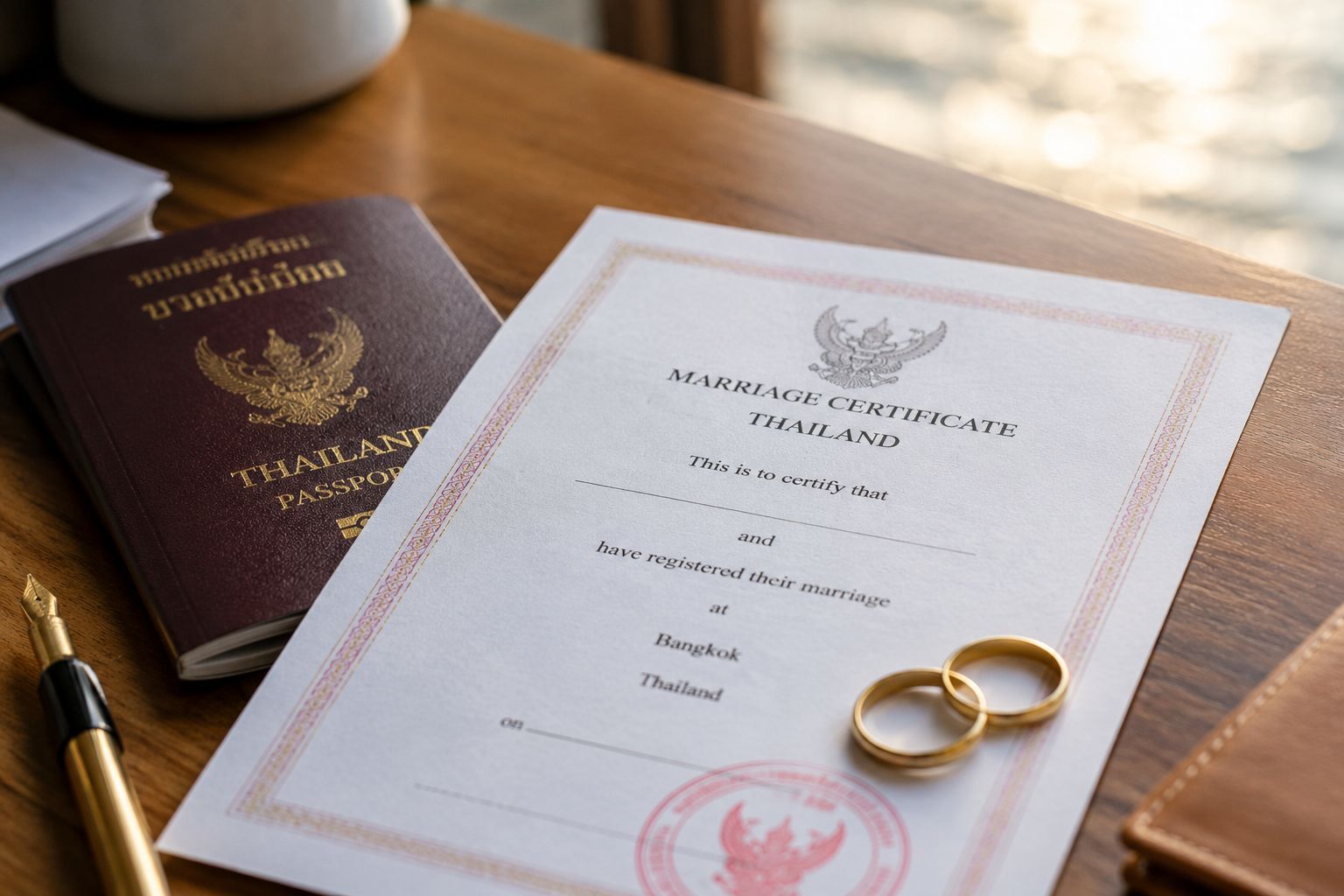
A barefoot ceremony on a Thai beach may feel effortless. The legal side is not quite so spontaneous. If you are asking can foreigners marry in Thailand, the reassuring answer is yes - but only if you handle the paperwork correctly and allow enough time before the celebration itself.
For many international couples, Thailand offers the rare combination of beauty, warmth and variety. You can exchange vows in a private villa, beneath palms by the sea, in a garden at sunset or within the quiet elegance of a traditional Thai setting. Yet the marriage becomes legally recognised through an administrative process, not through the ceremony alone. That distinction matters from the very beginning.
Can foreigners marry in Thailand legally?
Yes, foreigners can marry in Thailand, and the marriage can be legally valid. In practice, this usually means completing legal registration at a local district office, known as an amphur or khet, after preparing the required documents.
This is where many couples get caught out. A symbolic wedding in Thailand can be deeply personal and visually extraordinary, but it does not automatically create a legal marriage. If your priority is legal recognition, you need to complete the official civil registration process. If your priority is the experience, some couples choose to handle the legal paperwork in their home country and keep Thailand purely for the celebration.
Neither route is better in every case. It depends on your nationality, timeline, paperwork tolerance and how much administration you want folded into your wedding trip.
What documents do foreign couples usually need?
The exact paperwork can vary slightly depending on nationality, marital history and the district office handling the registration. That said, most foreign couples should expect to prepare passports, arrival stamps, and documents confirming they are free to marry.
For many nationalities, one of the key steps is obtaining an affirmation or affidavit from their embassy in Thailand stating that there is no legal impediment to the marriage. That document then often needs to be translated into Thai and legalised by the Thai Ministry of Foreign Affairs before it can be used at the district office.
If either person has been married before, additional evidence is normally required, such as a divorce certificate or the death certificate of a former spouse. Names also need to match across documents. Something as small as a spelling difference can create delays, especially once translation and legalisation are involved.
This is why couples should never assume that because a friend managed it in three days, the same timing will work for them. What looks simple on paper can become slower when embassies have limited appointments or when translations need correcting.
The legal process in Thailand, step by step
The broad sequence is usually straightforward, even if the details require care.
First, you gather the correct documents from home and check what your embassy requires. Some embassies issue the relevant declaration in Thailand, while others may have different procedures or may not provide the same service in the same format.
Next, the embassy-issued document is translated into Thai. After that, it is typically submitted for legalisation at the Ministry of Foreign Affairs. Only once that stage is complete can you move to the district office to register the marriage.
At the district office, both parties usually need to attend in person with passports and approved paperwork. Once the registration is accepted, the marriage is officially recorded, and you receive a Thai marriage certificate. Couples who need to use that certificate abroad may also need certified translations and, in some cases, further legalisation for use in their home country.
The process is manageable, but it is not one to leave until the day before your ceremony. A wedding timeline built around legal registration should always include a buffer.
How long does it take?
This is one of the most common planning questions, and the honest answer is that it varies.
In an ideal case, with all documents prepared correctly, some couples can complete the process within a few working days. In reality, it often takes longer. Embassy appointments, public holidays, translation turnaround and district office preferences all affect timing. If you are travelling from overseas, it is wiser to think in terms of at least several working days rather than a rushed same-week plan.
If you are combining legal registration with a destination wedding, it often makes sense to separate the two emotionally as well as practically. Complete the legal steps first, then enjoy the ceremony, photography and celebration without keeping one eye on official paperwork.
That approach creates a more relaxed experience, particularly if you are hosting guests.
Is it easier to have a legal or symbolic wedding?
For many international couples, a symbolic wedding in Thailand is the easier choice.
A symbolic ceremony gives you far more freedom. You can marry on a beach at golden hour, at a clifftop villa, in a tropical garden or in a more private setting that may not be suitable for legal registration. You also avoid the uncertainty of embassy rules, translations and legal office schedules during what is meant to be an intimate and joyful trip.
A legal wedding in Thailand, on the other hand, can be absolutely worth it if you want the country where you celebrate to also be the country where you formally marry. It feels meaningful to many couples to complete everything in one place. The trade-off is that the romance needs to coexist with bureaucracy.
There is no single right answer here. If you care most about ease and atmosphere, symbolic may be ideal. If you care most about making it official during your time in Thailand, legal registration can work beautifully with proper planning.
Can two foreigners marry in Thailand if neither lives there?
Yes. In most cases, residency in Thailand is not required for two foreigners to marry there. Couples regularly travel specifically for weddings or elopements without living in the country full-time.
What matters more than residency is documentation. You need to prove your identity, your freedom to marry and your lawful entry into Thailand. The district office is focused on whether your paperwork satisfies the legal requirements, not on whether Thailand is your permanent home.
That said, if one or both of you are arriving on a tight schedule, the practical side becomes more delicate. A short holiday with fixed flights leaves less room for document issues or office closures. Couples planning from abroad usually benefit from treating the legal process as a separate project rather than an afterthought.
Will the marriage be recognised in your home country?
Often yes, but you should always verify this with the relevant authority in your home country before making plans.
A marriage legally registered in Thailand is commonly recognised abroad, provided the paperwork has been completed correctly. However, recognition rules differ between countries. Some require translated and legalised certificates. Others may request registration with a local authority after you return home.
This is especially important for visas, name changes, tax records and future legal matters. A beautiful destination wedding should not leave you sorting out preventable administrative problems later.
Practical advice before you book the wedding itself
The most elegant destination weddings tend to feel effortless because the practical decisions were made early. Before you confirm a venue or ceremony date, decide whether your Thailand wedding will be legal, symbolic or a blend of both.
If it will be legal, build your plans around the paperwork first. Make sure your arrival date allows for official appointments and possible delays. Keep scanned and printed copies of every document. Check whether your documents need translation, certification or embassy approval before you travel.
If it will be symbolic, you can focus more fully on the setting and guest experience. That opens the door to more flexible formats, from intimate seaside vows to larger celebrations designed around sunset dinners, private lawns or refined villa weekends. For many couples, that is where Thailand truly shines - not just as a place to marry, but as a place to create a wedding that feels unmistakably your own.
And if you want both legal clarity and a beautifully choreographed celebration, working with a Thailand-based wedding specialist can make the process feel far lighter. The right support helps separate what must be done from what should simply be enjoyed.
Thailand rewards couples who plan with intention. Handle the legal side carefully, then give yourselves permission to savour the part you will remember forever - the light, the setting, the people you love, and the feeling that you chose somewhere extraordinary to begin.
For many international couples, Thailand offers the rare combination of beauty, warmth and variety. You can exchange vows in a private villa, beneath palms by the sea, in a garden at sunset or within the quiet elegance of a traditional Thai setting. Yet the marriage becomes legally recognised through an administrative process, not through the ceremony alone. That distinction matters from the very beginning.
Can foreigners marry in Thailand legally?
Yes, foreigners can marry in Thailand, and the marriage can be legally valid. In practice, this usually means completing legal registration at a local district office, known as an amphur or khet, after preparing the required documents.
This is where many couples get caught out. A symbolic wedding in Thailand can be deeply personal and visually extraordinary, but it does not automatically create a legal marriage. If your priority is legal recognition, you need to complete the official civil registration process. If your priority is the experience, some couples choose to handle the legal paperwork in their home country and keep Thailand purely for the celebration.
Neither route is better in every case. It depends on your nationality, timeline, paperwork tolerance and how much administration you want folded into your wedding trip.
What documents do foreign couples usually need?
The exact paperwork can vary slightly depending on nationality, marital history and the district office handling the registration. That said, most foreign couples should expect to prepare passports, arrival stamps, and documents confirming they are free to marry.
For many nationalities, one of the key steps is obtaining an affirmation or affidavit from their embassy in Thailand stating that there is no legal impediment to the marriage. That document then often needs to be translated into Thai and legalised by the Thai Ministry of Foreign Affairs before it can be used at the district office.
If either person has been married before, additional evidence is normally required, such as a divorce certificate or the death certificate of a former spouse. Names also need to match across documents. Something as small as a spelling difference can create delays, especially once translation and legalisation are involved.
This is why couples should never assume that because a friend managed it in three days, the same timing will work for them. What looks simple on paper can become slower when embassies have limited appointments or when translations need correcting.
The legal process in Thailand, step by step
The broad sequence is usually straightforward, even if the details require care.
First, you gather the correct documents from home and check what your embassy requires. Some embassies issue the relevant declaration in Thailand, while others may have different procedures or may not provide the same service in the same format.
Next, the embassy-issued document is translated into Thai. After that, it is typically submitted for legalisation at the Ministry of Foreign Affairs. Only once that stage is complete can you move to the district office to register the marriage.
At the district office, both parties usually need to attend in person with passports and approved paperwork. Once the registration is accepted, the marriage is officially recorded, and you receive a Thai marriage certificate. Couples who need to use that certificate abroad may also need certified translations and, in some cases, further legalisation for use in their home country.
The process is manageable, but it is not one to leave until the day before your ceremony. A wedding timeline built around legal registration should always include a buffer.
How long does it take?
This is one of the most common planning questions, and the honest answer is that it varies.
In an ideal case, with all documents prepared correctly, some couples can complete the process within a few working days. In reality, it often takes longer. Embassy appointments, public holidays, translation turnaround and district office preferences all affect timing. If you are travelling from overseas, it is wiser to think in terms of at least several working days rather than a rushed same-week plan.
If you are combining legal registration with a destination wedding, it often makes sense to separate the two emotionally as well as practically. Complete the legal steps first, then enjoy the ceremony, photography and celebration without keeping one eye on official paperwork.
That approach creates a more relaxed experience, particularly if you are hosting guests.
Is it easier to have a legal or symbolic wedding?
For many international couples, a symbolic wedding in Thailand is the easier choice.
A symbolic ceremony gives you far more freedom. You can marry on a beach at golden hour, at a clifftop villa, in a tropical garden or in a more private setting that may not be suitable for legal registration. You also avoid the uncertainty of embassy rules, translations and legal office schedules during what is meant to be an intimate and joyful trip.
A legal wedding in Thailand, on the other hand, can be absolutely worth it if you want the country where you celebrate to also be the country where you formally marry. It feels meaningful to many couples to complete everything in one place. The trade-off is that the romance needs to coexist with bureaucracy.
There is no single right answer here. If you care most about ease and atmosphere, symbolic may be ideal. If you care most about making it official during your time in Thailand, legal registration can work beautifully with proper planning.
Can two foreigners marry in Thailand if neither lives there?
Yes. In most cases, residency in Thailand is not required for two foreigners to marry there. Couples regularly travel specifically for weddings or elopements without living in the country full-time.
What matters more than residency is documentation. You need to prove your identity, your freedom to marry and your lawful entry into Thailand. The district office is focused on whether your paperwork satisfies the legal requirements, not on whether Thailand is your permanent home.
That said, if one or both of you are arriving on a tight schedule, the practical side becomes more delicate. A short holiday with fixed flights leaves less room for document issues or office closures. Couples planning from abroad usually benefit from treating the legal process as a separate project rather than an afterthought.
Will the marriage be recognised in your home country?
Often yes, but you should always verify this with the relevant authority in your home country before making plans.
A marriage legally registered in Thailand is commonly recognised abroad, provided the paperwork has been completed correctly. However, recognition rules differ between countries. Some require translated and legalised certificates. Others may request registration with a local authority after you return home.
This is especially important for visas, name changes, tax records and future legal matters. A beautiful destination wedding should not leave you sorting out preventable administrative problems later.
Practical advice before you book the wedding itself
The most elegant destination weddings tend to feel effortless because the practical decisions were made early. Before you confirm a venue or ceremony date, decide whether your Thailand wedding will be legal, symbolic or a blend of both.
If it will be legal, build your plans around the paperwork first. Make sure your arrival date allows for official appointments and possible delays. Keep scanned and printed copies of every document. Check whether your documents need translation, certification or embassy approval before you travel.
If it will be symbolic, you can focus more fully on the setting and guest experience. That opens the door to more flexible formats, from intimate seaside vows to larger celebrations designed around sunset dinners, private lawns or refined villa weekends. For many couples, that is where Thailand truly shines - not just as a place to marry, but as a place to create a wedding that feels unmistakably your own.
And if you want both legal clarity and a beautifully choreographed celebration, working with a Thailand-based wedding specialist can make the process feel far lighter. The right support helps separate what must be done from what should simply be enjoyed.
Thailand rewards couples who plan with intention. Handle the legal side carefully, then give yourselves permission to savour the part you will remember forever - the light, the setting, the people you love, and the feeling that you chose somewhere extraordinary to begin.